massteacher.org

MTA affiliates

Call to Union Members to Be on the DCE Negotiations Team

August 22, 2019

The Collective Bargaining Agreement (CBA) forThe Division of Continuing Education(DCE) is set to expire on August 31, 2020. A new DCE Negotiations Team needs to be constituted this fall to begin work starting in January 2020. The team, made up of the MCCC President and Vice President and a minimum of 5 DCE members, will be negotiating with management on hours, wages, and conditions of employment.

COMPENSATION: While the team is active, team members will receive a stipend each semester (fall and spring only) equal to a 3-credit course at Step Two under the DCE CBA.

DEADLINE: September 24, 2019

APPLICATION PROCESS: Please forward to presmwong@mccc-union.org a copy of your Resume/CV and a statement that addresses the following:

  1. what your role is at your community college
  2. why you want to serve on the DCE Bargaining Team
  3. what has been your involvement with the MCCC and your local chapter
  4. a description of any contract bargaining experience you have had
Filed Under: DCE, dce bargaining team

June 2019 Newsletter

June 13, 2019

Download Newsletter

MCCC_News_ June_2019

Filed Under: Newsletter, Newsletter 2019

Day Contract Ratification

June 7, 2019

The members ratified the Day Contract tentative agreement. The vote count is
Yes: 850
No: 46

  • Update on funding
  • Summary of the Tentative Agreement
  • Draft of Complete Tentative Agreement

Filed Under: Uncategorized

April 2019 Newsletter

April 30, 2019

MCCC April-May_2019

Download Newsletter

Filed Under: Newsletter, Newsletter 2019

Union Strength 2019 Delegate Assembly President’s Report

April 30, 2019

The union world has been on the move since my election to MCCC President a little over a year ago. Despite the Janus v. AFSCME Decision, support for unions has been steadily climbing. Far from the short-sighted anti-union perspective of Janus and his ilk prevailing, people are re-discovering that it is not good enough to just have a job. After all, what good is the creation of 1,000,000 more jobs, if those jobs demean employees and pay wages they can’t live on. Working conditions matter. Livable wages matter. Respect from one’s employer matters.

History has shown us that expecting employer altruism to improve salaries, working conditions and job security is a fool’s game. Collective bargaining is what gives us leverage to demand higher wages and improved working conditions. However, we cannot take for granted the existence of such leverage just because we are in a union. Unions are only as strong or weak as the people who belong to it. The strength of the MCCC lies in what I have come to think of as “the Donnie McGee factor.”

When I first started working in the Massachusetts Community College System almost two decades ago, I was lied to. I was advised by my Human Resources Representative not to join the State Employees Retirement System (SERS) because, he said, it was bankrupt, and I would never see my money again. So I got into the Optional Retirement Plan (ORP) with no inkling of how big a mistake that choice was. But Donnie McGee did know. She was hearing from people who told her how they were lied to; how they would never have enough in their ORP to retire. Something needed to be done. So Donnie went to work to get something done.

She was relentless at the statehouse. At MCCC events over the years, lawmakers presented with awards for their support of the MCCC, relayed stories of the countless ways in which she lobbied on behalf of others. When Section 60 passed to allow people in the ORP to buy into SERS, I watched Donnie step back again and again to allow others to take credit for the outcomes she single-handedly achieved because she didn’t care about credit. She cared about results and progress. She patiently and compassionately took on complaints and criticism from those who were displeased with the implementation of Section 60. She just kept working on their behalf no matter how they criticized her.

The question I have heard asked again and again is the following: “what can/will/has the union do/done for me such that I should pay dues?” Donnie asked, “what can I do to improve the lot of my union brothers and sisters.” Donnie’s is the right question. Therein lies the strength of unions. The MCCC would have no leverage at all if everyone sat back, expecting altruistic actions from others. The strength of the union does not lie in the exchange of dues for services. It lies in the Donnie McGee factor. We strengthen our union, when we improve the lives of those in the union. And that strength in turns gives us added leverage to further improve our working conditions.

So here is what I firmly understand now after almost one year of being the MCCC’s president: the question, “what union services do I get for the dues I pay?” is inherently anti-union. If the relationships between union members were merely transactional, a union does not really exist, and collective bargaining strength is undermined. The Donnie McGee factor has taught me the right question to ask, the question we should all be asking if we want to build greater union strength, is “what can I do to improve the lot of my union brothers and sisters?”


Filed Under: President's Column

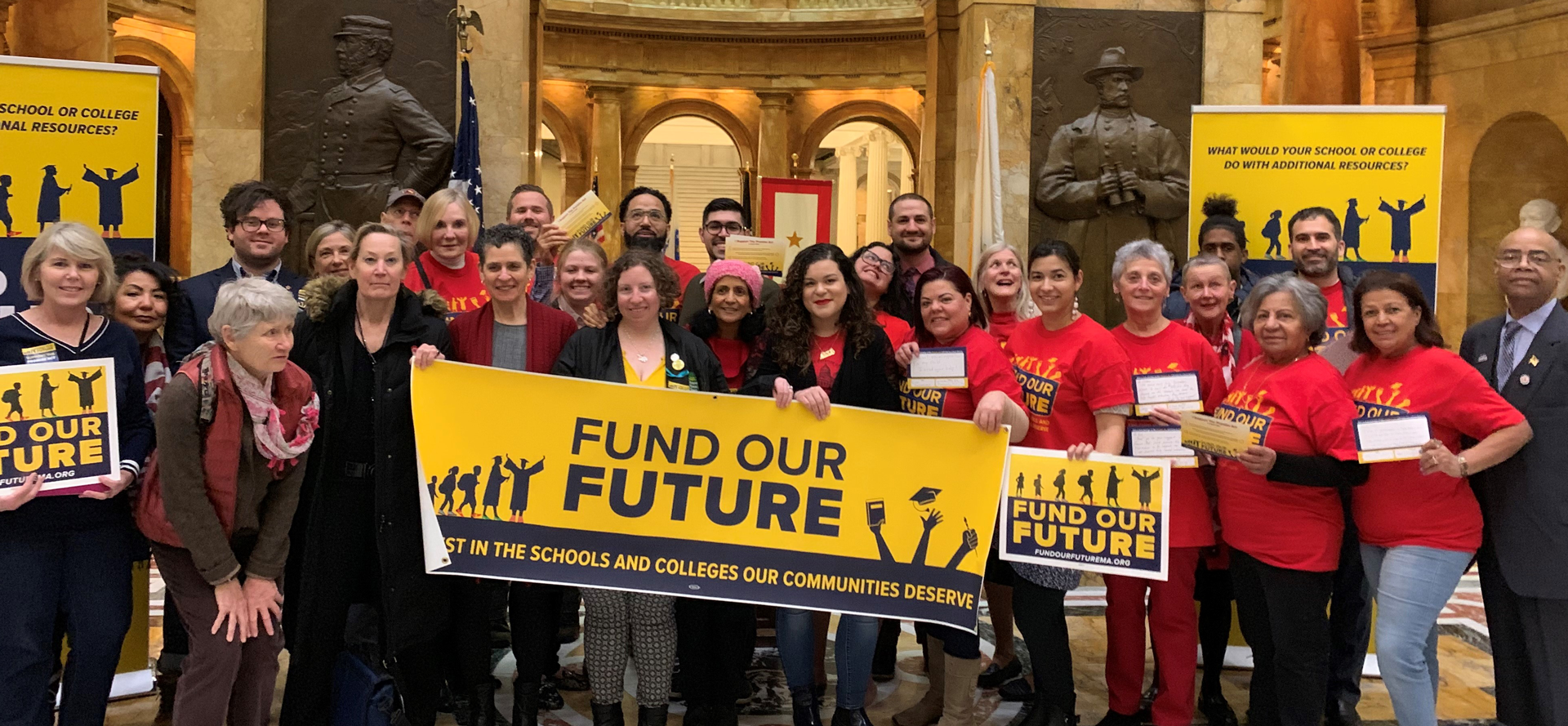
Fund Higher Ed!

April 26, 2019

Fund Higher Ed! Sign up to attend the Cherish Act legislative hearing April 30that 10:00 at the State House in Boston: NOTE TIME WAS CHANGED TO 10 AM

https://actionnetwork.org/events/hearing-on-the-cherish-act


Join us for the Fund Our Future Rally in Boston on May 16th:

RSVP today for the 5/16 #FundOurFuture Rally at the State House (Free bus transportation is available)


Filed Under: home-1

Day Negotiating Team

April 24, 2019

On May 22, 2019, the Day Bargaining Team arrived at a Tentative Agreement. TA details and information on ratification will be uploaded shortly.

Day Negotiating Team Updates

  • Day Negotiating Update May. 15, 2019
  • Day Negotiating Update April. 24, 2019
  • Day Negotiating Update Feb. 13, 2019
  • Day Negotiating Update Nov. 3, 2018
  • Day Negotiating Update June 27, 2018

Filed Under: Contracts, Day, day bargaining team

March 2019 Newsletter

April 4, 2019

Download Newsletter

MCCC_News_March 2019

Filed Under: Newsletter, Newsletter 2019

President’s Column March 2019

March 31, 2019

Community College As A Pathway to Lower Student Loan Debt

Student loan debt was on the mind of nearly everyone I chatted with the morning of March 21, 2019 (Higher Education Advocacy Day) at the Statehouse as I headed to the offices of my State Representatives to speak about the need for increased funding to public higher education. One student in her second year at UMass Amherst told me she was already carrying $20K in loans, and had just signed on to $15K more. Another student at Fitchburg State University was going to graduate in May with $35K in student loans. Even the Chief-of-Staff of my State Representative said her student load debt was such that her dream of going on to graduate school is all but at an end because she cannot incur any more debt.

Then at lunch I happened to sit at a table with two Journalism students from Cape Cod Community College. After we all listened to a speaker talk about her $60K student loan, one of the young woman said, “I’m so glad I’m going to a community college. I’m not going to have any debt when I graduate before I transfer to UMass.” Her friend concurred and said that she wondered why more people didn’t go to community college. She feels she has gotten an excellent education at CCCC and was ready to become an ambassador advocate for community colleges in the high schools to help others lower their student load burden

Completing a degree at one of the 15 community colleges before transferring to a state university or UMass was something I had brought up with the young man graduating from FSU as a way he could have cut his debt in half or even eliminated altogether because there was so much funding support for community college transfer students that is not available to those coming straight from high school. I thought he was going to say something in response like, “I didn’t really want to go to a community college.” Instead he said, “I never thought of doing that. No one ever told me it was a possibility.”

Amazingly, community college transfer is still a secret. In the world of ever-increasing student loan debt, it is a secret with not only economic, but moral and social justice, implications as well. Many of the Commonwealth’s young people can right now cut their debt in half or more if they begin their 4-year undergraduate degree in one of the community colleges of Massachusetts. They don’t have to wait for that day in the hopeful future, after they have incurred their debt, when legislation is passed to make public higher education debt free. To be sure, debt-free higher education is a worthy goal but, for now, it is still a pie-in-the-sky dream when measured against the nightmare of loan statements detailing a 20-year plan of loan repayment before one have even settled into one’s first post-college job.

So why has community college as a pathway to lower student debt been such a secret? Two reasons: ignorance and snobbery. Parents, counselors, even people within the community colleges themselves are unaware of the existence of high quality programs such as, to hear the students tell it, Journalism at CCCC. They are unaware of the agreements that exist between the Community Colleges and the public four-year universities that allow students to transfer seamlessly into the four-year institutions. And they are unaware of the myriad merit- and need-based funding opportunities that exist for community college students that are not available to students coming directly from high school.

Then there is the snobbery, which is constantly reinforced by the punchline politics of higher education: some public figure does not understand something? They must have gone to a community college. It is this superficial perception of cachet, or the lack thereof, that is at the heart of the college admissions bribery scandal that has shaken the world of higher education. Parents apparently will go to criminal lengths to have their children connected to a “prestigious” higher education institution

Things need to change now. Continuing to indulge our pretentious leanings while we burden young people with crushing debt is unsustainable. We need to persistently counter the jokes and erroneous narratives that contribute to the negative perception of our community colleges. High school counselors and parents need to be better educated about the transfer options and funding opportunities at our community colleges. For the sake of our future it is time to become truly proud of our community’s two-year public colleges

Filed Under: President's Column

Newsletter Feb. 2019

February 28, 2019

Download Newsletter

MCCC_News_ Feb.2019\

Filed Under: Newsletter, Newsletter 2019

  • « Previous Page
  • 1
  • …
  • 4
  • 5
  • 6
  • 7
  • 8
  • …
  • 28
  • Next Page »

Copyright © 2026 · Publication Theme on Genesis Framework · WordPress · Log in