massteacher.org

MTA affiliates

President’s Column Nov. 2017

November 16, 2017

Union Solidarity. What Is at Stake?

There will be a number of external challenges facing unions in the months ahead. If we are to survive and preserve our strength to collectively bargain agreements that improve the working conditions for our members and the learning conditions for our students, we must come together in solidarity of purpose.

On October 2, 2017, the United States Supreme Court began a new term. As one of its first acts, the Court has agreed to hear Janus v. AFSCME, which will determine whether the First Amendment operates as a constitutional “right to work” law in the public sector. The issue was before the Court two years ago in Friedrichs v. California Teachers Association, which ended with a 4-to-4 tie vote following the death of Justice Antonin Scalia. All eyes are now on Trump’s appointee, Neil Gorsuch, to cast the deciding vote in Janus.

The Janus case represents a decades long campaign by the National Right to Work Committee and other anti-labor groups to prevent state and local governments from entering into “fair-share fee” arrangements (called “agency fees” within MCCC). Allowing the sharing of fees represents decades of cooperative labor history in collective bargaining.

A statement released by leaders of our nation’s four largest public-sector unions – the American Federation of State, County and Municipal Employees (AFSCME), the National Education Association (NEA), the American Federation of Teachers (AFT), and the Service Employees International Union (SEIU) – called the Janus case “a blatantly political and well-funded plot to use the highest court in the land to further rig the economic rules against everyday working people.”

If Janus passes, the rights of workers Union to organize and share the costs associated with collective bargaining will be severely limited.

Across the Commonwealth, unionized faculty and staff at our community colleges, state universities, and UMass campuses have been attempting for months to negotiate successor contracts with the state. The financial offers are less than cost of living increases and amount to pay cuts. The lack of funding by the state in supporting public higher education contributes to course cancellations; increased use of adjunct faculty and part-time employees who lack wage parity, job security and benefi ts; and more hikes in tuition and fees for students. Meanwhile, the state’s per-student investment in public education has declined 31% since 2001.

SEIU 509, representing Tufts University part-time faculty, won a tentative contract agreement with its administration on October 10, 2017—one day before a massive faculty walkout. After seven months of negotiations, the proposed five-year contract achieved fairer pay, better job security, more paid professional development opportunities, and other benefits for its part-time faculty. Highlights included:

  • Significant pay increases: Over half of the part-time faculty will see a raise of 22.5% over the life of the contract. Others will receive a minimum 12.5% pay increase during this contract
  • Job Security and Professional Courtesy: There will be stronger provisions governing the review and appointment process. Faculty will receive earlier notification if their contract will not be renewed, giving them adequate time to find other employment.
  • Professional Development: Tufts will expand the eligibility criteria to improve access to fund for paid professional development opportunities for faculty.

The achievement of this SEIU contract demonstrates the power of solidarity of action that involves all stakeholders including students and the community served and demonstrates that “When we fight, we win.”

The MCCC DCE/adjunct unit bargains with the 15 Massachusetts community college presidents because the unit must, by law, be totally self-supporting. But, we go far beyond being self-supporting. The MCCC DCE/adjunct unit of over 4,500 underpaid, non-benefited adjuncts who teach 70-85% of all community college credit courses is actually a “revenue generator” for the community college system—the “cash cow,” if you will. Yet, less and less of that generated revenue goes to supporting teaching and learning.

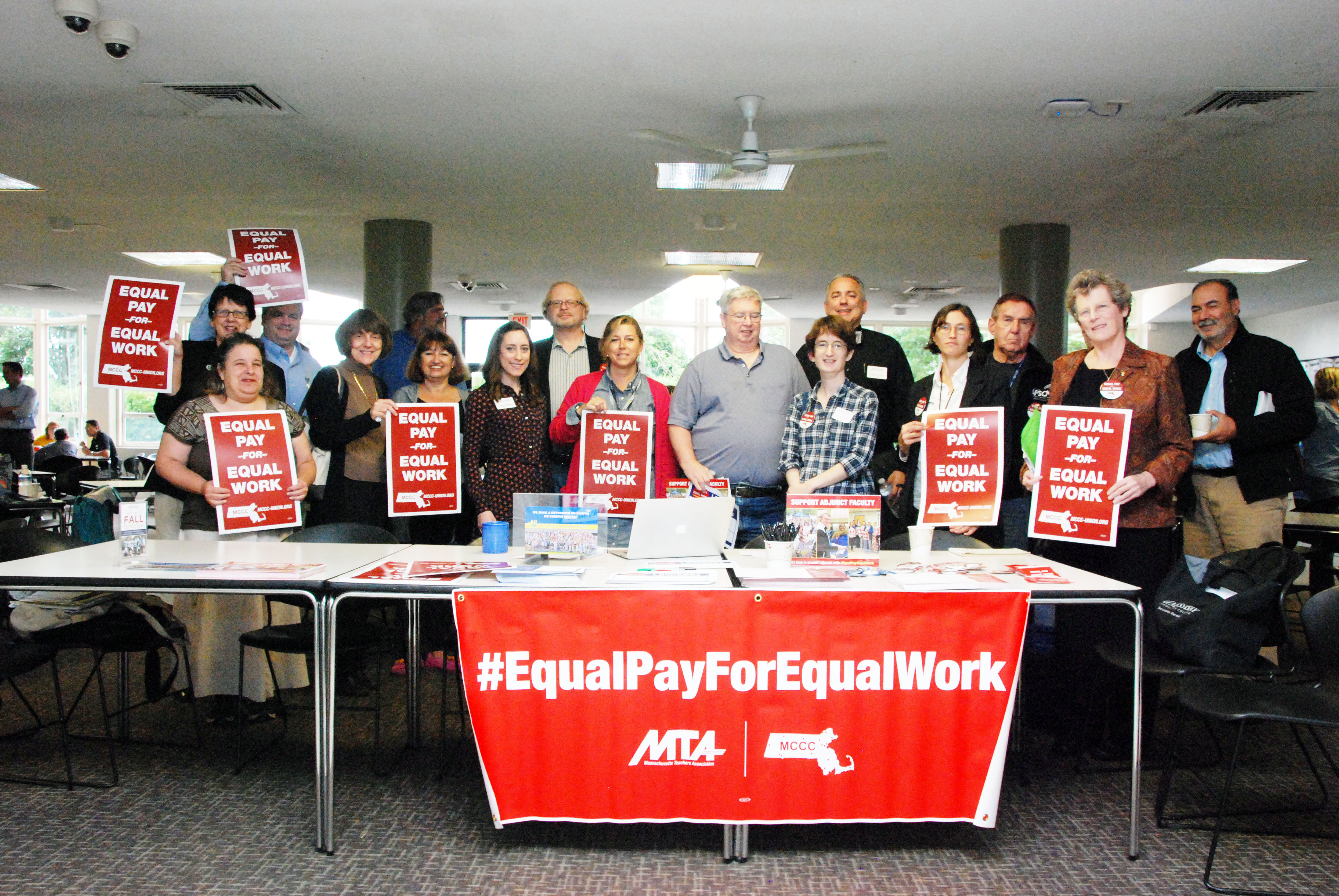
The time is ABSOLUTELY NOW to stop the exploitation of adjunct faculty and to provide #EqualPay4EqualWork for instruction to all faculty within the Massachusetts community college system, whether full-time or part-time.

The MCCC adjunct (DCE) unit has been bargaining with the employer (community college presidents) for over 440 days and (while negotiating two years of a three year contract that expired on May 31, 2016) has been offered 0% and 1%, which would give adjunct faculty an insulting $10.66 – $12.88 per credit raise over two years.

The lowest-paid adjunct faculty (Step 1) currently receives $3,198 for teaching a 3-credit course. The highest-paid adjunct faculty (Step 4) currently receives $3,864 for teaching a 3-credit course. The revenue generated (tuition and fees) by that same 3-credit course (based on $619 for 3-credit in-state tuition/fees times a maximum enrollment of 32 students per course) amounts to $19,808. The revenue surplus after taking out direct costs for faculty instruction is $15,944 to $16,610 per 3-credit course. Even with just 15 students per course, the Colleges generate $9,285 per 3-credit course with a revenue surplus of $5,421 to $6,087 per each 3-credit course.

The revenue exists to provide for pay parity for adjunct faculty.

The MCCC Board of Directors is being asked to support DCE (adjunct) contract negotiations through the use of strategic actions, including Work-to-Rule that was successfully used in reaching an agreement on MCCC Day unit contract negotiations in 2015

It is time for the Board to zealously represent the DCE/adjunct Unit and authorize aggressive actions to reach a contract settlement that respects the work of adjunct faculty.

Filed Under: President's Column

Campus Equity Week National Day of Action

October 31, 2017

That’s VP Jeff Seideman on the right in the very identifiable red MCCC organizing t-shirt.

Campus Equity Week National Day of Action with informational picketing at Westfield State University

Filed Under: Day, DCE

Oct. 2017 Newsletter

October 31, 2017

  • DCE Contract: Chapters Turning Up The Heat
  • MCCC Nominations Open Nov. 2
  • Democracy or Tyranny? The DA Voted for Democracy
  • Stipend Committee Reports/Recommends
  • Research Reveals Important Trends
  • Radical Thoughts from An Old Guard
  • Download Newsletter
MCCC Oct-2017_

Filed Under: Newsletter, Newsletter 2017

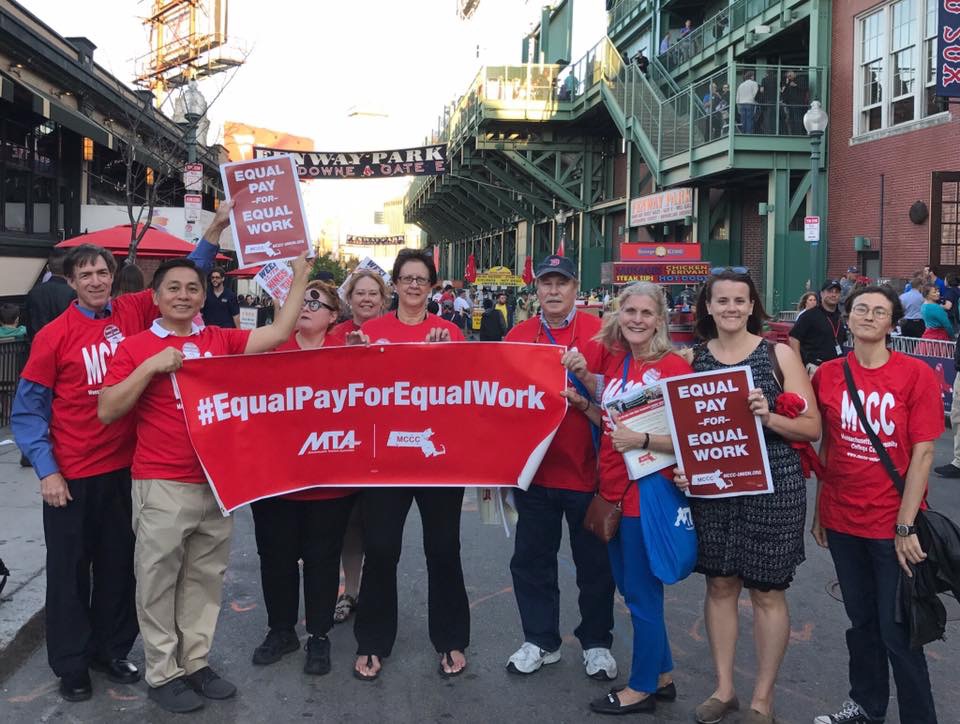
Community College Appreciation Day at Fenway

October 3, 2017

9/28/17 Sox vs Astros
All 15 Massachusetts community colleges were represented by a student, faculty, and/or College President or staff person and were invited onto the field for special recognition.

Filed Under: DCE

MassBay Professional Day

September 24, 2017

MassBay Chapter shows support at its Professional Day on 9/22 for DCE negotiations. College President David Podell states in opening remarks, “We support our adjunct faculty.” #EqualPay4EqualWork Photo by: Don Williams, MCCC Communications Coordinator

Great display of support for DCE negotiations today at MassBay!!  Special thanks to MassBay Chapter President Bob Tarutis, FT faculty member Nina Keery, and adjunct member Susan Copen!!!!  Signatures were also collected for Raise up Massachusetts ballot initiatives to raise the minimum wage and to provide for paid family and medical leave.  Inspiring morning!

Mass Bay College President David Podell acknowledged the College’s support for adjunct faculty as part of his formal address to the assembly of mostly full-time employees.  

He also plugged Community College Appreciation Day at Fenway on Thursday, September 28.  Our 15 College Presidents and a student from each of our 15 community colleges will be welcomed onto the field in recognition of the great work we do as community college faculty and staff in supporting student success and supporting our communities.   

Sox are playing the Houston Astros.  MassBay has great t-shirts for their college employee contingent.  Come on out to the game!

Come early and meet up with MCCC members at Cask n Flagon at 4:30 p.m.  Contact Heather LaPenn for more info.


Filed Under: DCE

Sept. 2017 Newsletter

September 20, 2017

  • DCE Bargaining–Time for Action
  • WANTED: Day Bargaining Team Members
  • How Can We End This Divisiveness?
  • One Adjunct’s Perspective On Delegate Assembly
  • MTA Summer Conference-Organizing
  • Download Newsletter
MCCC Sept-2017_

Filed Under: Newsletter, Newsletter 2017

President’s Column Sept. 2017

September 20, 2017

Renewing Our Commitments

Our union needs to recapture the energy, the spirit, and the commitment that enabled the labor movement to play a key role in shaping our country; in giving dignity and respect to workers through advancing working conditions, wages, and benefits; and bringing a better quality of life to families.

Our work is education. Most of us entered community college teaching and academic support because we are passionate about the mission of improving lives through education…one student at a time. Quality public education is something people had to fight to win, and our unions (MCCC/MTA/NEA) have been and continue to be central to that fight to provide the learning and working conditions needed for student success and to provide the schools our communities deserve

Members=Power. As a union of members, we need to renew our commitment to democracy, to civility, and to working together for the common good. This past year, we have been caught in a cycle of recrimination among a small inner circle within the Board focused on attacks. Most members want an end to the squabbling and want the leadership at all levels president, vice-president, secretary, Board of Directors, chapter presidents to focus on union solidarity and on advancing our work as education professionals.

After 38 years of full time teaching, I ran for statewide MCCC President because I wanted members’ voices to be heard, because I wanted us to advance equality for adjuncts, and because I value openness and transparency. And, despite the political distractions within leadership, we have succeeded in accomplishing many of these goals this past year:

  • New, previously unengaged members have become involved and are now serving on statewide committees and many were first-time attendees at the MCCC, MTA, and NEA Delegate Assemblies.
  • Our DCE bargaining team is strong in its commitment to achieve a contract that respects the work and contributions of our adjunct faculty. Our bargaining process is more transparent; members, for the first time ever, have been invited to observe negotiations!
  • A DCE bargaining support team was created to work with Chapter Presidents to provide ongoing member support for contract negotiations.
  • The Day contract was finally signed and printed well past ratification, and the Day contract Salary Grid was brought to a successful ratification vote despite almost impossible timeline constraints.
  • Resources were expended to develop and strengthen chapters weak in member involvement, to provide stipends to members to attend conferences and workshops, and to support leadership training forums for local chapter presidents and for members seeking greater involvement in their union.
  • A new and improved MCCC website was launched, providing ease of use and the ability to be viewed on multiple devices from computers to smartphones.
  • We entered into social media with the creation and launching of an MCCC Facebook Page.
  • A Fall Conference open to all unit members at no cost is scheduled for October 26. Workshops of interest to members are being planned.
  • The Bylaws and Rules Committee brought forward 13 new bylaw proposals to the Delegate Assembly in April despite the proposals not being acted upon.
  • The Nominations and Elections Committee took over the statewide elections process and heard an appeal on a Spring 2017 chapter election that failed to provide absentee ballots; the Committee’s decision was that a new chapter election be held in Fall 2017.
  • A Blue Ribbon Ad Hoc Committee was formed to review our MCCC policies on reassigned time/stipends given to Board members and others (currently valued at $3,423 each) to ensure that member dues are being used responsibly and that there are accountability measures in place; a report is due to be presented to the Board in August or September.

Renewed commitments are needed not just for the MCCC but for all public sector unions as we are about to face an unprecedented attack on our very existence. It is almost certain that the Trump Supreme Court (in the Janus case) will issue a decision that will abolish agency fee provisions for all public sector unions nationwide in an attempt to destroy unions by requiring unions to provide many of the benefits of the contract but without requiring non-members (agency fee payers) to pay anything for the services they receive.

If we are to survive the attacks, we need to renew our commitment to the core value of unionism: to bring economic justice to the workplace and social justice to our nation. Our power as a union is in our MEMBERS collectively standing together in solidarity to advance respect for our profession and to advocate for our students; it does not reside in top-down leadership.

We need to come together, talk with each other, and democratically decide what matters to us. As individuals, power resides with management. As a union of engaged members, we hold shared power and have to be taken seriously. We have seen this past year, through the work of MTA, that “when we fight, we win.”

MTA is launching an “All In: Building Union Power” campaign: “Public education is under assault. The threat of privatization is real. Public educators must speak out. We must use the power of our collective voices to promote and protect the ideals that are vital to helping students learn and succeed.”

The campaign requires grassroots member organizing through member-to- ing. For example, we worked with the MTA to develop House Bill 639, called the “Faculty Restoration and Equity Fund,” which is now before the Joint Committee on Higher Education. H639 calls for pay parity, access to health care and a state pension, a state contribution to the Smart Plan, and priority hiring for adjuncts.

In recent bargaining sessions, some of the issues on the table have been:

Sick Leave: we have improved the conditions for using sick leave, but language has not been finalized. Lab instructors do not get equal treatment for their lab-hour, sick-time computation. The good news is that management has dropped its insistence that only deceased members can cash out their unused sick leave. Now you can get it upon retirement – while you’re still breathing.

Job Postings: The union had been asking for preference in full-time job openings, but management was adamantly opposed. The union continues to demand more timely assigning of courses for adjuncts to give them adequate time for preparation.

DCE MACER improvement: A number of college presidents do not participate in Management Association Committee for Employee Relations (MACER) meetings. The union has asked for stronger language covering MACER with a train- member conversations. For MCCC, with our vast s y s t e m o f 15 community colleges spread across the state and with our diversity of students and over 7,000 members, the challenge is to develop member communication networks on each of our college campuses with a cadre of trained members willing to pledge to talk with twenty other members.

I will be visiting chapters this year and working with chapter presidents in developing this network. If we can do this, we will be a far stronger union – for enforcing our contracts, for winning better contract terms, and for putting our issues on the political map. I am willing to travel across the state to meet with members to discuss shared values and how we can build power to bring about better contracts (currently negotiating DCE but Day negotiations will soon begin), to achieve equity through legislation (HB.639), and to get financial resources for our colleges through the Fair Share Amendment. Members interested in greater union engagement may also contact me directly at president@mccc-union.org or by calling 508.947.5822. I want to meet you; your voice matters!

#Respect4MCCC.

In Solidarity

Diana Yohe, MCCC President

Filed Under: President's Column

Two bills focus on ending exploitation of adjuncts

July 7, 2017

The contributions that adjunct faculty members make to higher education are enormous, but the compensation they receive in doing so is pitiful.  Read Full Article

Filed Under: Contracts, DCE, In the News

CALL FOR ACTION!!! H.639

June 23, 2017

Read the Bill Summary

All Members, Family, and Friends
6/29 hearing on H.639
Request to take a “selfie” with member’s own comments on the provided sign and hashtag it #EqualPay4EqualWork and #RespectMCCC  #RespectAdjuncts

download image
2017_Adjunct_sign_fillable color

download image
2017_Adjunct_sign_fillable

Filed Under: DCE, In the News, Part time

DAY CONTRACT SALARY GRID RATIFIED

May 16, 2017

The Salary Grid Committee has completed its discussions regarding a new salary grid system that, if ratified, will be incorporated into the 2015-18 Day Unit Collective Bargaining Agreement (CBA) and take effect July 1, 2017. The MCCC Board of Directors has voted to unanimously recommend its ratification. Below are materials regarding the salary grid so you can learn more before you cast your ratification vote.

Note: The ratification materials should arrive at your home address around Thursday of this week. If you’re a Day unit member and you don’t receive a ratification package, please contact the MCCC office at (508) 890-6688. Your ratification ballot must be received at the MCCC office by 4pm on Wednesday, May 31st. Please ensure you leave enough time for mailing and remember there’s no mail on Memorial Day, May 29.

Documents concerning the salary grid

Mailed materials:

  • MCCC Salary Grid Coverletter (pdf) – This explanatory cover letter accompanies the mailed ratification ballot.
  • MCCC Salary Grid Summary FAQ’s (pdf) – This document provides a basic summary of how the grid system will work and answers frequently asked questions about the grid.  This document will also accompany the mailed ratification ballot.

 Other education materials

  • MCCC powerpoint presentation – A presentation that explains the grid
  • MCCC Salary History (pdf) – An important document that provides the historical context for this agreement.
  • Published Grids Faculty (pdf) – Find the faculty salary grids here.  There is one for each faculty rank.
  • Published Grids Professional Staff (pdf) – Find the professional staff salary grids here.  There is one for each professional staff grade.
  • Salary Grid Memorandum of Agreement – This document outlines in detail the agreement that will be implemented between the MCCC and the Board of Higher Education if ratified.
  • Additional Frequently Asked Questions– This document will be updated regularly to cover additional questions posed about the Salary Grid system.

Questions?

The salary grid committee can be reached at this email SalaryGrid@mccc-union.org

Ratification Notice

Filed Under: Contracts, Day

  • « Previous Page
  • 1
  • …
  • 8
  • 9
  • 10
  • 11
  • 12
  • …
  • 28
  • Next Page »

Copyright © 2026 · Publication Theme on Genesis Framework · WordPress · Log in